
Story
Why PollutionIQ exists
I grew up in Zenica. And as much as I love this city, there is one thing that has been like a stone in my stomach all my life: in winter, Zenica often does not breathe — it suffocates.
I remember the morning when you open the window and instead of fresh air you are greeted by the smell of smoke. I remember a gray sky that doesn't look like fog, but like something that sticks to the face and goes down the throat. And I remember that feeling when you wonder, "Where exactly is this coming from?"
Of course, we all have our doubts. There is heavy industry, the Ironworks and chimneys that have been part of the Zenica landscape for many decades. But it's not just that. There are also home fireplaces, traffic, and even the wind that carries air from where you don't expect it. Sarajevo, for example, does not have heavy industry like Zenica, so again it has the same problem. And Kakanj, only twenty kilometers upstream of the Bosna River, has a thermal power plant and a cement plant — major sources of pollution. It's all stirring above our heads, and we live below.
Today I have an 8-year-old girl. And when I look at her, all of that takes on a different meaning. Because it’s no longer a question of “what we’re used to,” but rather “what we’re leaving behind for our children.” I don’t want my child — or anyone else’s child — to grow up in a city where in winter they plan their day based on whether they can breathe.
And then comes another frustration: data. In the inner city area of Zenica, there are only two air quality measurement devices, both at federal hydrometeorological stations. And that would be “okay” if they always worked and if those two places could realistically show the situation for a city of over 100,000 inhabitants. But they often don’t work, sometimes they’re unreliable, and in practice, that’s too few measurement points.
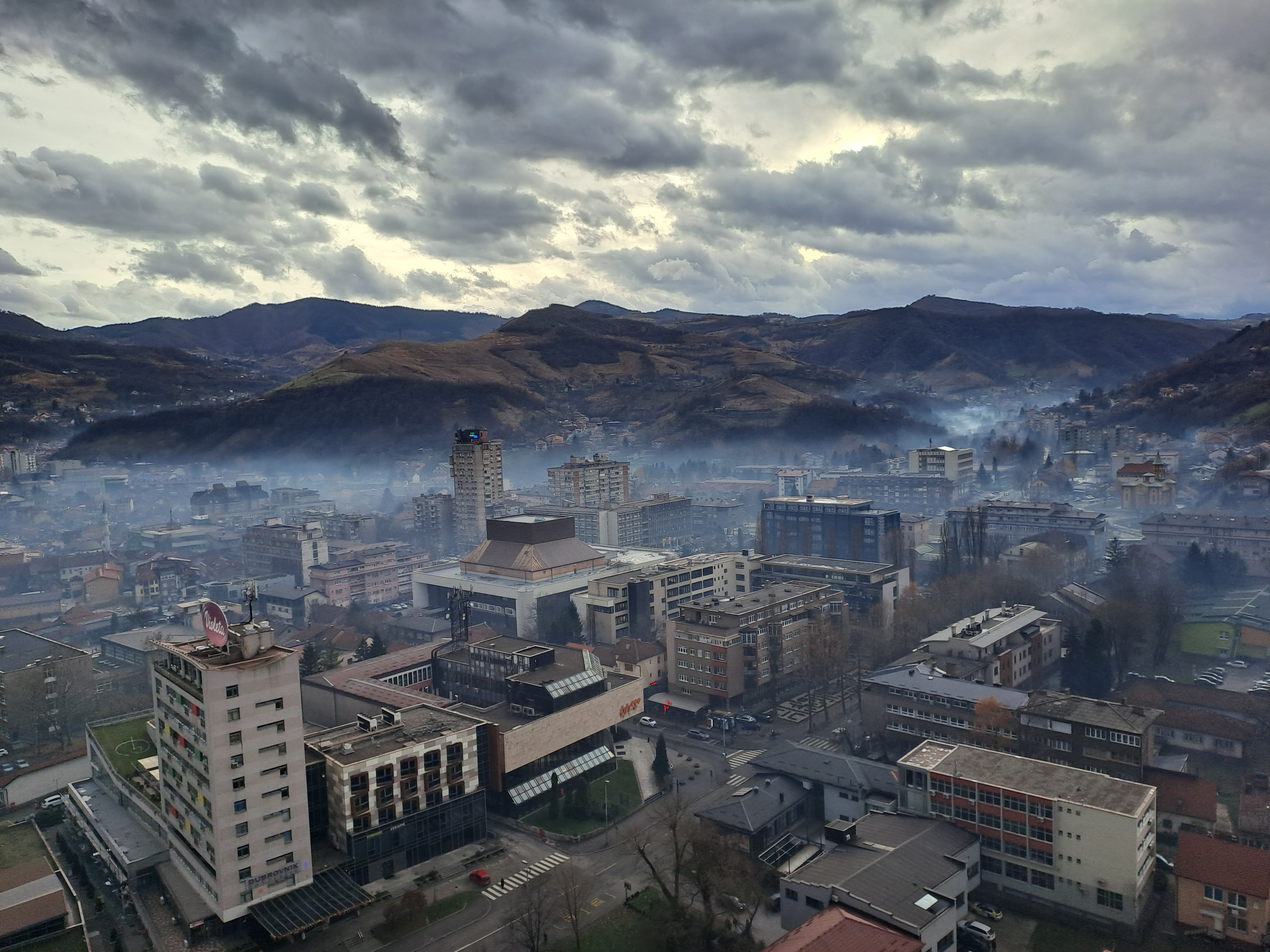
View from above - one of the better days.
Another image that symbolizes everything to me: there used to be a display in the city center, on a tall building, that showed the date, time, and pollution. People could just look up and know where they were. The display is still there. But it hasn't worked for five years. It's just there — as a silent reminder that we've given up on the most basic thing: knowing what we're breathing.
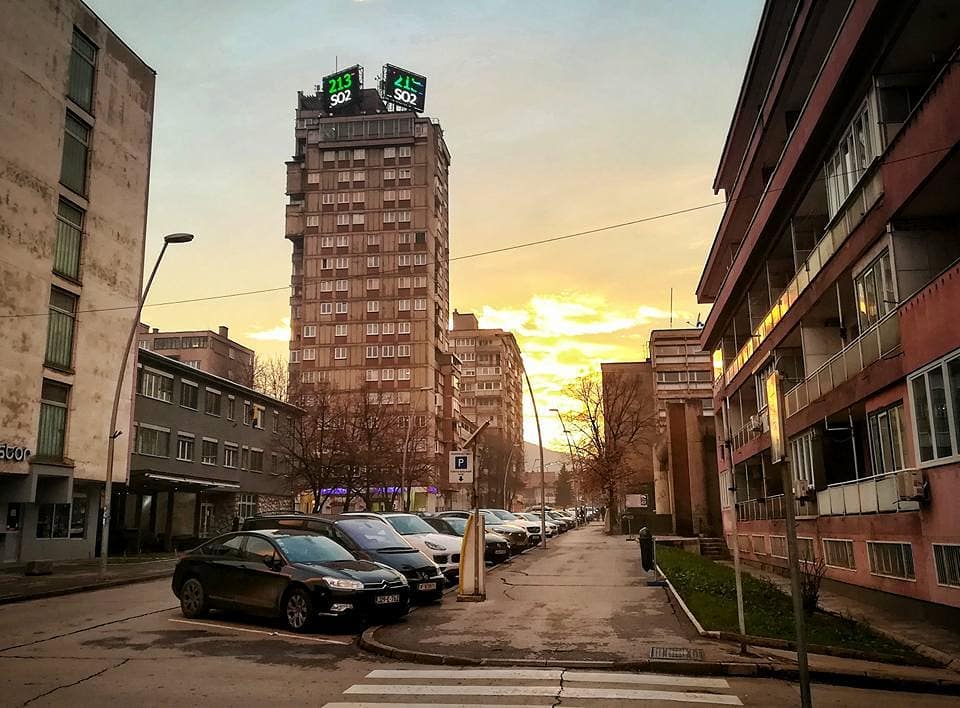
The city-center display that no longer works.
I'm not an ecologist by profession. I don't fully understand all the atmospheric layers, winds, and air chemistry. But I do know what I'm best at: technology. Computers. Programming. Digital communications. I know how to build systems that work, how to collect and display data, how to turn a "story" into a tool.
And this wasn't an idea that came to me overnight. I've been thinking about it for a long time. A simple question kept coming back to me: Why don't we have more measuring points around Zenica — enough to finally see a pattern, not just assumptions?
That's why the idea came to me to set up a network of 12-25 sensors around Zenica: some basic (PM2.5/PM10), and some advanced (in addition to particles and CO₂ and certain gases/compounds, plus temperature and humidity). Not to “prove” anything in advance, but so that for the first time we can calmly look at the data and say: this is a trend, this is a spike, this is recurring, this is coming from here, this is happening then.
If pollution spikes around industry at the exact moment when thick smoke is visually visible — then that’s a clue.
If pollution spikes at 3:00 p.m., when the afternoon rush hour begins — then that’s a clue.
If the most distant sensors show an increase when the wind “carries” air from tall chimneys — then that’s a clue.
I might be right about something. Maybe I won’t. But what I can do is the most important thing: I can bring data where it doesn’t exist.
I can help parents know when it’s not a playground day.
I can warn the elderly and chronically ill when the air is too toxic to walk around.
I can give environmental organizations — and citizens directly — a tool to put pressure on polluters and decision-makers, not through arguments and guesswork, but through numbers and measurements.
For data transfer, I plan to use the Helium network: it is global, intended for low data flow, consumes little energy and already exists in many urban areas. And through the Solana ecosystem, it is possible to transparently monitor the flow of data and costs, and enable a simple "reward" or compensation model for those who are willing to place a sensor on a window, balcony or roof. The idea is to make everything clear, visible and transparent.
Air quality sensors are mostly available. And what is not available — I will make it myself.
The project initially remains hyper-local: Zenica. But if it works here, there is no obstacle to copying the model to other cities that have the same problem.
It is important for me to emphasize: this is a non-profit project. Nobody makes money here. This is a common good. But there are costs: sensors cost, data transmission costs, solar panels and installation materials cost, servers cost, sometimes the installation site itself costs. Therefore, if you can, support the project with a donation — via crowdfunding platforms or directly.
Support the project
Donations help us fund sensors, hosting, and ongoing operations.
- Patreon: https://www.patreon.com/c/pollutioniq
- WhyDonate: https://whydonate.com/fundraising/pollutioniq
-
XMR (Monero):
49D8Vbe2cpsiWxHhgjfExz2NECvdoaZhoJS33gaiUbPhY2PJZQuQfsbhR7pyGsxaEP4UkPhiWz6kCc9j7YzVs1psTMHxo4G
-
Solana:
8tpfmCKdDFY35xudhQoTjAyGGWoVWSSGqZh5jsJhZmLh

Scan to donate (Solana)
I don't believe this project will change the world. But I sincerely believe it can change someone's day. It can save someone's health. It can help me finally speak up. My name is Emir, and you can find more about me or contact me on LinkedIn.